SEO链轮:打造不可检测的链轮(链轮策略图)
How can you get your website to the top for competitive keywords? You setup a network of websites that you control! Here’s how you can use the authority and trust of web2 properties to gain higher SERPs. What you will need is at least 24 unique articles, minimum 300 words. You can write them yourself or outsource them. Then you will register at any of the following web2 properties, but make sure you choose at least 24. If you know or use any similar web2 property, you can of course use that instead.
Weebly, Zimbio, Hub Pages, Ever.com, Squidoo, Vox, Quizilla, Wet Paint, Live Journal, Scribd, Buzzle, Clear Blogs, Ezine Articles, Tumblr, Blogger, WordPress, Kongregate, Xanga, Bloglines, Mylot, Goarticles, Helium, Associated Content, Swik.net, Edublogs.org, Blog.com, Blogetery, Insane Journal, Blogsome
Use the following diagram and fill the green, blue and gray buttons randomly with your own web2 properties. This is gonna be your own personal diagram. It doesn’t matter where in the diagram you place a certain web2 property, what matters is the linking.
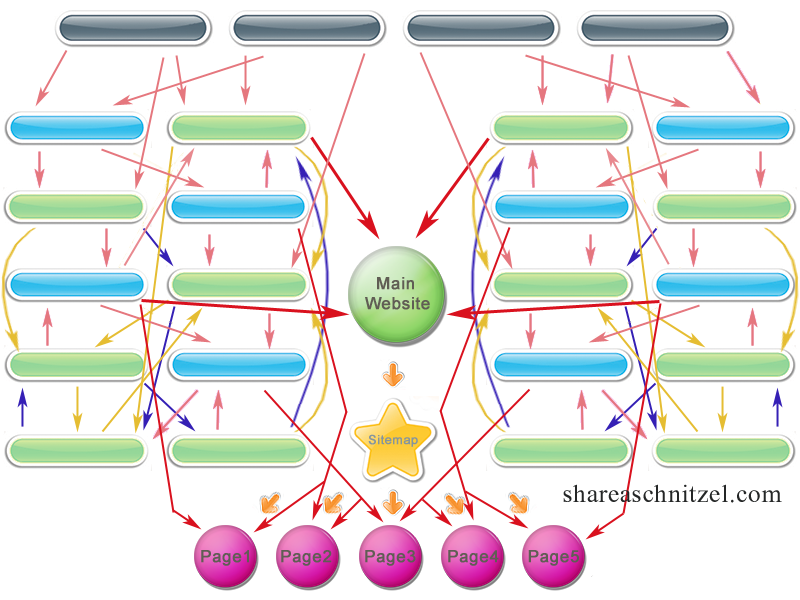
Green Buttons are the backbone. They receive links from everywhere and are interlinked in a way that is virtually undetectable by algorithms. It’s called a Hamiltonian path which is an NP-Complete problem. An NP-Complete problem is a problem that there’s no known exact algorithm to compute it, only approximates can be used. Keep in mind that because of some links going from the green buttons into blue ones, it kinda breaks the perfect Hamiltonian path, but if we weren’t to do that we would be left without further diversification and the benefits that the blue (and gray) buttons give us.
Blue buttons are secondary sites which further strengthen the green network, as well as link to inner pages of our main website.
Gray buttons are fillers that are not linked from anywhere in the network (although they can be). They provide some more strength for the entire network and act as some kind of distraction, since they’re neutral (not linked from anywhere).
Yellow arrows represent the links between the green network.
Blue arrows represent the Hamiltonian path which carefully directs the juice into the upper green button, which should be the strongest site in your network. This website then links to your main website.
Red arrows are links to your main website or pages from your main website.
Pink arrows randomly interlink your entire network.
As you’ve probably noticed, the right side of the image is an exact replica of the left one, or vice versa. They are actually 2 networks, because they’re not linked to each other in any way. The only difference is that the left network links to page1 and page2 of your main website, while the right network links to page4 and page5. This acts more as a trap for any similarity filters that google might use. If google sees such similarities they could devalue your links, but I have never experienced this issue myself. Ideally, just in case you would want to add or remove a website to change the structure and interlinking of the network and thus its similarities to the second. The more locations you can get links from the better. Not just because you’re getting more links but because it looks more natural to the search engines to get links from many places.
Because there are two networks, you could use just one if your keyword is not that competitive. You can add more later anyway. You also can add strength to your network by getting links to any of the websites. The whole process is pretty time consuming and most won’t implement it. That’s exactly why YOU have to do it. Get yourself the advantage of not being lazy and do the work. Stop whatever you’re doing and start implementing a linking strategy based off this diagram. It will be the single most important SEO campaign you did in a while.
DUE TO POPULAR DEMAND
Here is a link service you can order. I’ve worked out a deal for my readers where you can get $32 OFF any one linkfarm.
Here’s What Nikola’s Team Will Do For You:
1) Write 2 unique 550-600 words articles
2) Spin each article
3) Make accounts on 24 social sites and submit articles
4) Make manual interlinking like on diagram above
5) Submit these 24 properties to 50 social bookmarking sites and 50 rss feed aggregators
6) Send report to you
Turn around time – two weeks
主要翻译:
绿色、蓝色和灰色的按钮,都是一些高PR的WEB2.0网站或页面。例如新浪博客、网易博客、博客大巴之类的第三方博客平台;还有就是一些文章投稿网站,在站长界最有名的就是A5、ChinaZ之类的。
绿色按钮是整个站群中最核心的部分,所有站与站之间都是靠绿色按钮联系起来的,绿色按钮会有很多各种各样的站链接到他们,在图中就标示出来可以利用50 个社会书签和50个RSS订阅站点,就是把我们绿色按钮的站尽可能多的提交到书签站或RSS订阅站(因为目前书签站和RSS站的权重都是非常高的)。由于 绿色按钮的导入链接来自于外界各个网站,因此搜索引擎算法是很难侦测到,其实这就是完美的哈密顿路径(NP),但是在我们自身站群中绿色按钮和蓝色按钮之 间也是有链接的,虽然这种做法容易被搜索引擎算法侦测到,但是也是为了利用站群的权重传递,这样才能达到站群权重利用最大化。
蓝色按钮的站在这中间主要起到一个权重的传递作用,把绿色按钮集中的权重通过蓝色按钮的站传递到我们主网站的内页去,在上面这个图中,我们应该能够很清晰的看到。
灰色按钮虽然也是属于站群中的一部分,但是作用和50个社会书签+50个RSS站的作用是差不多的,都是为了让整个站群看起来更加自然,同时传递一些权重到绿色和蓝色按钮的站。
黄色箭头代表绿色按钮之间的联系,这个链接只是单向链接,例如A->B,就不能B->A了,一定要注意这一点。
红色箭头就是从绿色和蓝色按钮链接到主网站或主网站内页。
粉红色箭头是在整个站群中随机链接的。
蓝色箭头就是最主要的链接,这就是链轮的核心,其实就是把所有的绿色按钮链接起来,把所有的权重传递到最后一个绿色按钮站,最后这个绿色按钮站再链接到主网站,这样主网站就能获得最大的权重。
目前这个站群+链轮的模型对百度和谷歌都是非常有效的,目前大家平常注意到的QJ百度的站群还只是比较简单的那种站群,就是整个站群中随机链接,还没有像这样人为的控制链接及权重导向。